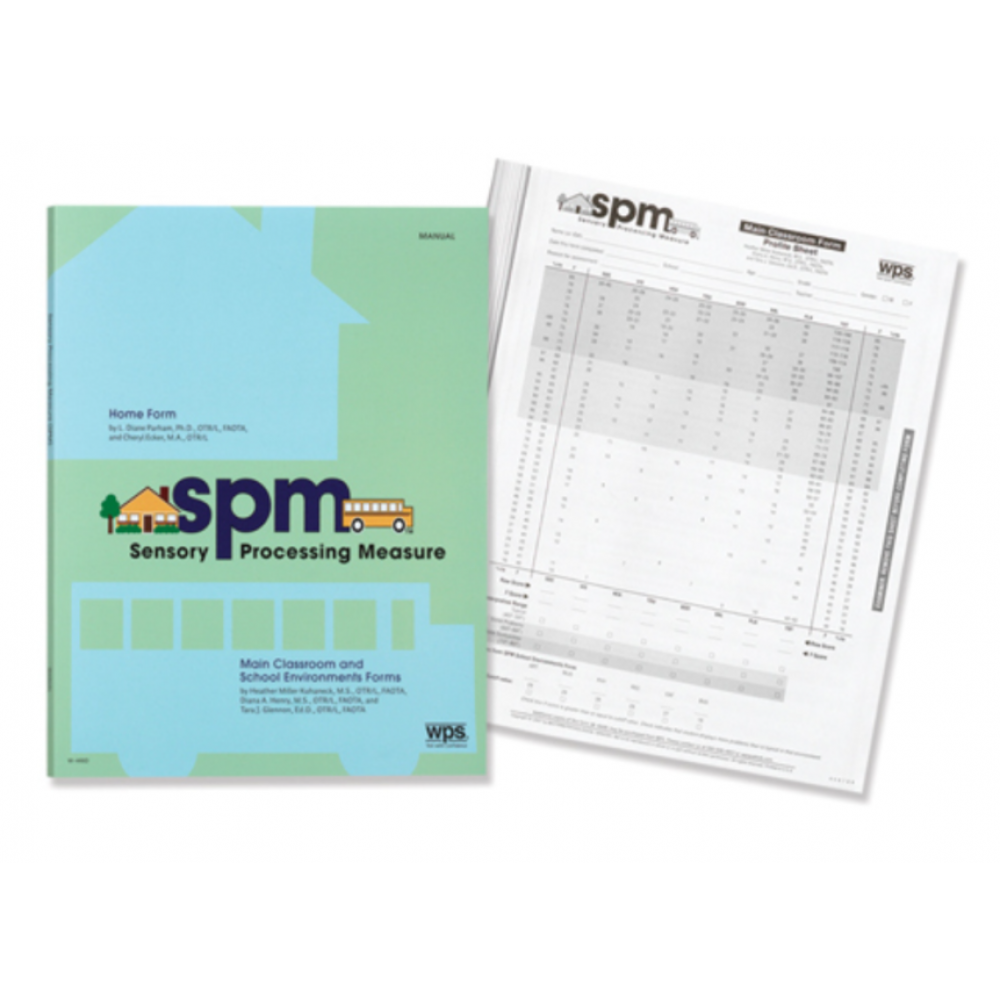
The (SPM™) Sensory Processing Measure is now out of print - the record forms are still available. The new (SPM™-2) Sensory Processing Measure, Second Edition is now available. (Not currently available from Pearson).
Recognising that sensory processing problems often manifest differently in different environments, this set of three integrated rating scales assesses sensory processing, praxis and social participation in school children 5-12 years old
Benefits
- Complete picture of children's sensory functioning at home, at school and in the community
- Multi-environment approach lets you see why a child who functions well in a highly structured classroom may have problems in a more relaxed setting
- Descriptive clinical information on processing vulnerabilities, including under- and overresponsiveness, sensory-seeking behaviour, and perceptual problems.
Features
- Firmly grounded in sensory integration theory, the SPM provides norm-referenced standard scores for two higher level integrative functions -praxis and social participation - and five sensory systems - visual, auditory, tactile, proprioceptive, and vestibular functioning.
- Consists of three forms:
- Home Form (75 items) - completed by the child's parent or home-based care provider
- Main Classroom Form (62 items) - filled out by the child's primary classroom teacher
- School Environments Form (10 to 15 items per environment) - completed by other school personnel who work with and observe the child.
Home and Main Classroom Forms
Each requiring just 15 to 20 minutes, the Home and Main Classroom Forms yield eight parallel standard scores:
- Social Participation
- Vision
- Hearing
- Touch
- Body Awareness (proprioception)
- Balance and Motion (vestibular function)
- Planning and Ideas (praxis)
- Total Sensory Systems
Scores for each scale fall into one of three interpretive ranges: Typical, Some Problems or Definite Dysfunction.
In addition, for the first time, an Environment Difference score permits direct comparison of the child's sensory functioning at home and at school. While the scales on the Home and Main Classroom Forms are identical, the items themselves are specific to each environment. Individual item responses reveal how sensory difficulties manifest in these two different settings.
School Environments Form
Provided on an unlimited-use CD, this form lets you look at the child's functioning in six school environments outside of the main classroom: Art Class, Music Class, Physical Education Class, Playground, Dining Room, and School Bus.
Each environment has its own Rating Sheet, which can be printed and distributed to raters as needed. Each rater can complete his or her 15-item Rating Sheet (10 items for the School Bus setting) in less than 5 minutes.
Each Rating Sheet is interpreted using a cutoff score for the environment to which it applies. Scores at or above the cutoff point indicate that the child is experiencing an unusually high number of sensory processing problems in a given environment. Whether you use one or all six Rating Sheets, the School Environments Form must always be administered in conjunction with the Main Classroom Form; it cannot be used alone.
Because it solicits input from school staff members who are not normally involved in assessment - the art teacher and school bus driver, for example - the School Environments Form serves a team-building function. It educates school personnel about sensory processing disorders and uses their observations to obtain a more comprehensive picture of the child.
Comprehensive, Clinically Rich and Psychometrically Sound
The Home Form and Main Classroom Form were standardised on a demographically representative sample of 1,051 typically developing children in reception through to year 7 (in the US).
For the Home Form scale scores, internal consistency (a) estimates ranged from .77 to .95 (median = .85), and test-retest reliability estimates ranged from .94 to .98 (median = .97). For the Main Classroom Form scale scores, internal consistency estimates ranged from .75 to .95 (median = .86), and test-retest reliability estimates ranged from .95 to .98 (median = .97). A subsample of 306 children from the standardisation sample was used to develop scores and establish cutoff criteria for the School Environments Form.
The School Environments scores yielded internal consistency values ranging from .82 to .91 (median = .89). A separate sample of 345 children receiving occupational therapy intervention was used to verify that the SPM scales can differentiate typical children from those with clinical disorders. In addition, factor analysis and correlational studies provided evidence for the validity of the scale scores. Studies reported in the Manual document that the SPM differentiates typical children from those with clinical disorders.