
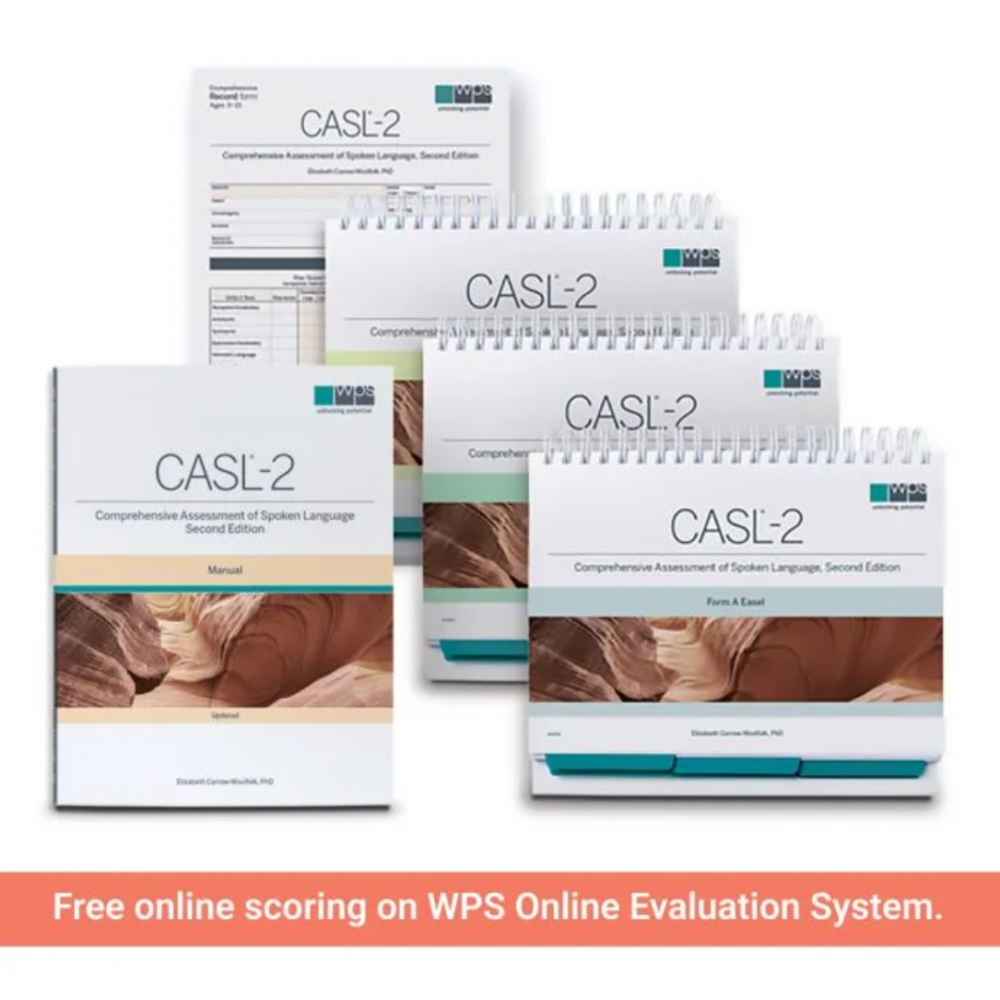
(CASL-2) Comprehensive Assessment of Spoken Language, Second Edition
Product Description
Benefit
Measures the oral language processing skills of comprehension and expression across four categories: Lexical/Semantic, Syntactic, Supralinguistic, and Pragmatic
Norms
Based on a stratified sample of 2,394 individuals that is representative of the U.S. population in terms of geographic region, gender, race, and SES/parent education
Scores
Free online scoring on WPS Online Evaluation System. 14 individual test scores and six index scores: General Language Ability Index (overall skill), Receptive Language Index, Expressive Language Index, Lexical/Semantic Index, Syntactic Index, and Supralin
Format
Individually administered; examiner reads items aloud as the examinee responds by speaking or pointing.
Admin Time
5 to 10 minutes for each test and 45 minutes for the General Language Ability Index (known as the Core Composite in the original CASL)
Ages
3 to 21 years
Publish Date
2017
Qualifications
Level C required.
What’s New in the CASL-2
- All new normative data and more extensive clinical groups
- 14 individual tests (the original CASL’s Paragraph Comprehension test was removed)
- An expanded age range for most of the 14 tests to include younger children
- Updated item content to address current technology (no more payphone!)
- Full-color easels featuring new artwork that is more engaging for young children
- Alternative scoring guidelines for African-American dialect
- Updated record form design that makes scoring easier and includes an Item Analysis Worksheet for each test, to help develop intervention plans and write IEP goals
- Easy to remember start and stop rules that are consistent across all tests
- Up to 6 index scores (tailored to each age group using Factor Analysis to include their most salient skills)
- FREE online scoring and reporting through the WPS Online Evaluation System (platform.wpspublish.com)
Overview
The Comprehensive Assessment of Spoken Language, Second Edition is the most up-to-date measure of oral language skills available. It offers the flexibility of 14 stand-alone tests in one comprehensive yet specific battery. Preserving the strengths of the original and highly regarded test, the second edition introduces new and enhanced features to increase validity, functionality, and ease of use.
The CASL-2 shares the same underlying theory as the new Oral Passage Understanding Scale (OPUS) and the popular Oral and Written Language Scales, Second Edition (OWLS-II). Since all three tests are based on the author’s Integrative Language Theory, they provide a cohesive evaluation across a broad range of areas. While the OWLS-II provides an evaluation of oral and written language, the CASL-2 offers a more in-depth picture of 14 spoken language skills. The new OPUS measures listening comprehension and how well a person can apply these skills.
Applications and Uses
The CASL-2 can be used by speech-language pathologists and other professionals in settings such as schools, clinics, hospitals, private practices, and intervention programs. When you need to evaluate response to intervention (RTI), you can use the CASL-2 to track improvement over time. It can help answer a variety of referral questions, including eligibility for speech services, placement in special education, determining the presence of a language delay or disorder, or the measurement of language abilities in English learners. The CASL-2 provides important information for everyone involved in the treatment of children and young adults to reach their potential at school, at home, at work, and in the community.
What It Measures
For children and young adults ages 3 to 21, the CASL-2 measures spoken language across four structural categories:
- Lexical/Semantic: Knowledge and use of words and word combinations
- Syntactic: Knowledge and use of grammar
- Supralinguistic: Knowledge and use of language in which meaning is not directly available from the surface lexical and syntactic information
- Pragmatic Language: Knowledge of language that is appropriate across different situational contexts and ability to modify language according to the social situation
Within these categories, 14 stand-alone tests give you flexibility in measuring the specific areas of interest. Each test can be interpreted separately and/or test scores can be combined to get an overall picture of oral language skills. The CASL-2 tests feature extended age ranges to start assessment and intervention earlier, as well as track progress in a child over time. Besides the inclusion of younger ages, all tests now extend to the age of 21.
Test items are designed to focus on areas of interest (for example, synonyms, antonyms, idioms, and so on) to reduce or eliminate the need for memory where possible. This is achieved by using pictures and repeating words at the beginning and end of each item. Please see the table on 6 for a description of each test. The CASL-2 Pragmatic Language Test is particularly useful for measuring social communication skills in people with an autism spectrum disorder or social (pragmatic) communication disorder, it measures the ability to understand and apply societal rules and expectations. It is the only performance test that measures pragmatic language abilities in children under age 6.
Standard scores are available for the following:
- Each of the 14 tests (specific skill scores)
- Lexical/Semantic Index, Syntactic Index, Supralinguistic Index (categorical index scores)
- Receptive Language Index and Expressive Language Index (language processing index scores)
- General Language Ability Index (GLAI) (overall skill index score)
You can quickly isolate the specific skill, category, or processing ability that you want to assess. If a single score is needed for a student’s eligibility for speech services or placement in special education, the GLAI can be determined by administering just 4 to 5 tests. The back of each record form has a chart that shows required tests to obtain index scores based on the examinee’s age. Specific skill scores are available, such as descriptive ranges, confidence intervals, percentile ranks, test-age equivalents, and grade equivalents, to enhance detail and functionality. Index scores are also available as descriptive ranges, confidence intervals, and percentile ranks. Alternative scoring guidelines offer criteria for scoring results with individuals who speak with different dialects for accurate measuring.
How It Works
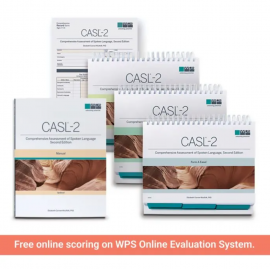
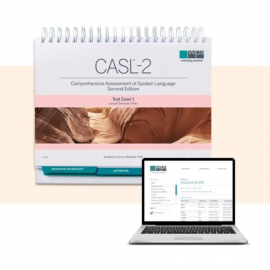
Using one of three self-standing test easels, read items aloud as the examinee responds by speaking or pointing. All easels feature full-color illustrations for more engaging administration, especially for young children, and use updated items to address current technology. The easels also include instructions, examples, pictures, items, prompts, samples of correct and incorrect answers, scoring criteria to streamline the administration process, and tabs to easily flip to needed tests.
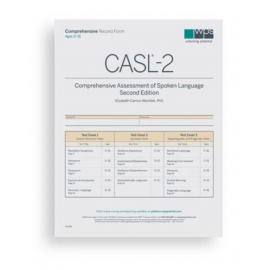
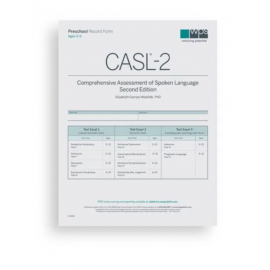
There are two CASL-2 record forms, the Comprehensive Form and the Preschool Form, both described in the table (below). Using the appropriate form, record the examinee’s responses by hand. Across the 14 tests, suggested Start Items allow you to skip nonapplicable items dependent on the individual’s age. Consistent basal and ceiling rules (four correct items in a row and four incorrect items in a row, respectively) save time by making it easy to remember when to stop an administration.
Both CASL-2 record forms now include a fold-out panel to easily transfer raw scores to the Score Summary page for standard scoring conversion. Additionally, both forms include an Item Analysis Worksheet per test, providing qualitative information to help write IEP goals and intervention plans. It highlights the examinee’s strengths and areas of improvement, giving a level of detail that extends beyond a standard score.
FREE Online Scoring and Reporting
Upon purchase of a CASL-2 Kit or Form, you gain access to digital scoring and reporting through the WPS Online Evaluation System—at no additional charge! This gives you the option to score online and automatically generate useful reports, including a Score Report with Item Analysis, Progress Report, and Profile Summary Report. Time-saving and HIPAA compliant, WPS’s online testing platform lets you securely and conveniently keep a record of your administrations and share helpful information with parents, teachers, and others involved in treatment.
A print record form is required for administration.
A recent study compared performance on the CASL-2 using remote administration vs. in-person, and the findings support the validity of remote administration, suggesting that both methods of administration should yield similar results.
Comprehensive Form
- Contents: All 14 tests; covers all ages (3 to 21 years old)
- Format(s): Print (score by hand or online)
Preschool Form
Contents: The 10 tests that can be used with children ages 3 to 6 years old
- Format(s): Print (score by hand or online)
Easel 1
- Contents: Lexical/Semantic tests
- Format(s): Online; Print
Easel 2
- Contents: Syntactic tests
- Format(s): Online; Print
Easel 3
- Contents: Supralinguistic tests and Pragmatic Language test
- Format(s): Online; Print
Manual
- Contents: Everything you need to know to use the CASL-2; includes norms tables in a single, comprehensive book
- Format(s): Online; Print
| W-685 | CASL-2 Kit | Email for quotation |
| W-685A | CASL-2 Comprehensive Form (Pack of 10) | Email for quotation |
| W-685B | CASL-2 Preschool Form (Pack of 10) | Email for quotation |
| W-685C | CASL-2 Easel 1 | Email for quotation |
| W-685CP | CASL-2 Digital Easel 1 | Email for quotation |
| W-685D | CASL-2 Easel 2 | Email for quotation |
| W-685DP | CASL-2 Digital Easel 2 | Email for quotation |
| W-685E | CASL-2 Easel 3 | Email for quotation |
| W-685EP | CASL-2 Digital Easel 3 | Email for quotation |
| W-685M | CASL-2 Manual | Email for quotation |
| W-687 | CASL-2 and OPUS Combination Kit | Email for quotation |
When you order from google.com, you will receive a confirmation email. Once your order is shipped, you will be emailed the tracking information for your order's shipment. You can choose your preferred shipping method on the Order Information page during the checkout process.
The total time it takes to receive your order is shown below:

The total delivery time is calculated from the time your order is placed until the time it is delivered to you. Total delivery time is broken down into processing time and shipping time.
Processing time: The time it takes to prepare your item(s) to ship from our warehouse. This includes preparing your items, performing quality checks, and packing for shipment.
Shipping time: The time for your item(s) to tarvel from our warehouse to your destination.
Shipping from your local warehouse is significantly faster. Some charges may apply.
In addition, the transit time depends on where you're located and where your package comes from. If you want to know more information, please contact the customer service. We will settle your problem as soon as possible. Enjoy shopping!