Provides a brief yet robust measure of crystallized and fluid cognitive ability, generating a quick estimate of overall cognitive functioning and impairment
Based on a representative sample of 2,826 individuals, presented separately for children and adults, and stratified by age
Scale scores and a Composite score indicating overall cognitive ability–all provided as standard scores; plus an Impairment Index
Level C required.
Since its original publication in 1940, the Shipley Institute of Living Scale has been widely used to assess cognitive functioning and impairment. Revised and restandardized, this enduring test continues to offer a brief yet robust measure of both crystallized and fluid intelligence—now with updated norms, an expanded age range, a nonverbal Block Patterns scale, and unlimited-use computer scoring. The Shipley-2 is an excellent choice whenever you need a quick estimate of cognitive ability. Brief and easily administered to individuals or groups, it is well suited to educational, clinical, rehabilitation, geriatric, neuropsychological, forensic, and human resource applications.
A Brief Measure of Crystallized and Fluid Abilities
Like the original test, the Shipley-2 measures two aspects of cognition:
Crystallized knowledge—That gained through education and experience
Fluid reasoning—The capacity to use logic to learn and acquire new information or solve problems
Because it assesses both kinds of ability, the Shipley-2 can be used not only to obtain a quick estimate of overall intelligence but also to reveal cognitive impairment. Research shows that crystallized ability is relatively stable, while fluid reasoning is affected by aging, injury, and psychopathology. By uncovering discrepancies between the two, the Shipley-2 can provide evidence of cognitive deterioration.
Two Options for Measuring Fluid Ability
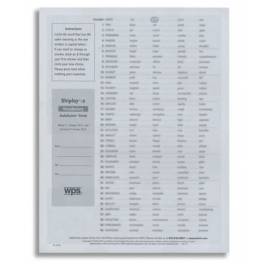
To measure crystallized ability, the Shipley-2 includes a 40-item Vocabulary scale. Each item requires the respondent to look at a target word and then choose from four options the word that is closest in meaning.
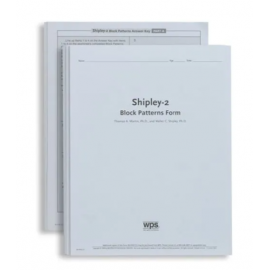
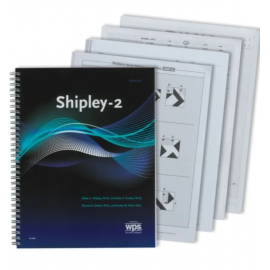
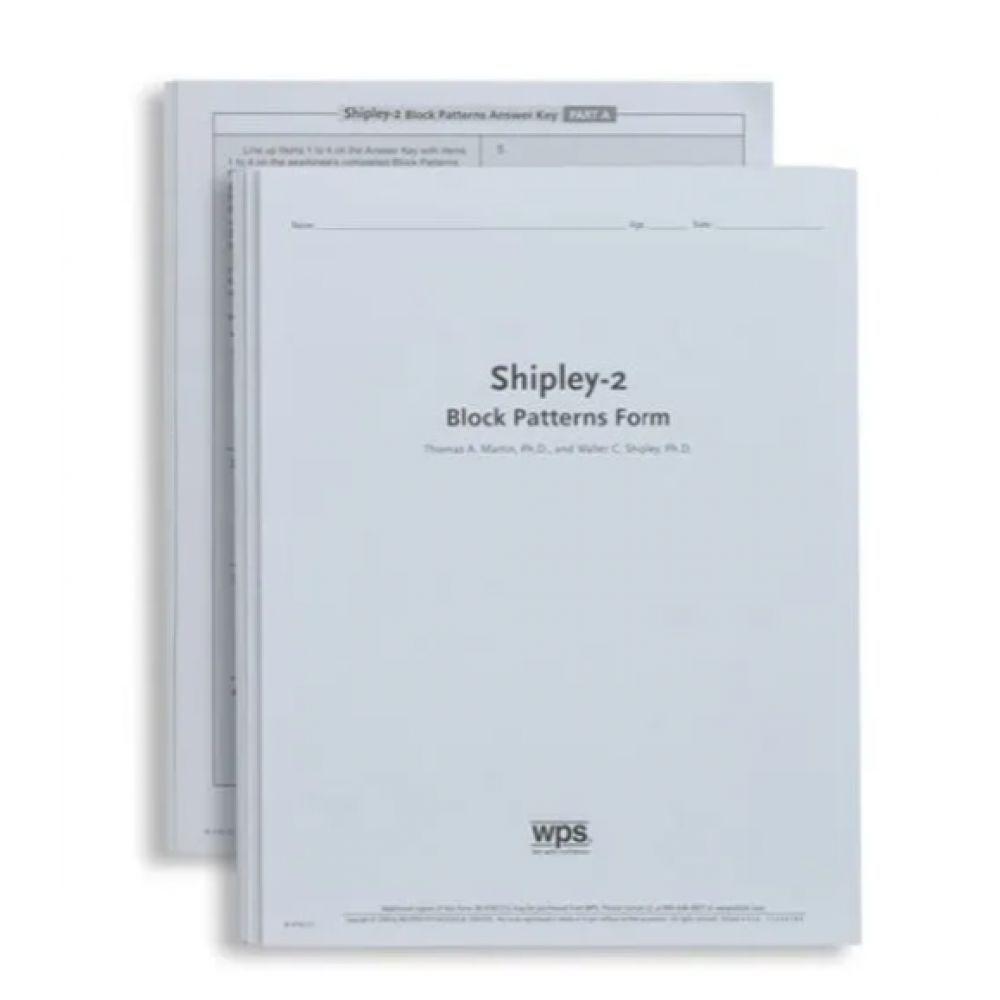
To assess fluid ability, the test offers two options: the Abstraction scale, which presents 25 sequence-completion items similar to those in the original Shipley; and the new Block Patterns scale, composed of 12 multiple-choice items based on the well-known Kohs cube designs. While the Abstraction scale has the advantage of being familiar to Shipley users, the Block Patterns scale is a good alternative when you need a nonverbal measure of fluid ability—or when you prefer the simplicity of a multiple-choice response format. The Manual offers guidance in selecting one over the other.
Easy Administration, Scoring, and Interpretation
The Shipley-2 can be administered to individuals or groups in just 20 to 25 minutes, and scored in 5 minutes more. Norms are based on a sample of 2,826 individuals representative of the U.S. population in regard to ethnicity, gender, and educational level. They are presented separately for children (7 to 19) and adults (17 to 89) and stratified by age.
The test produces standard scores for the scales administered, as well as percentiles, age equivalents, and confidence intervals. It also provides a Composite score, which is formed by combining the Vocabulary score with either the Abstraction score or the Block Patterns score.
Composite A Composite B
Vocabulary score Vocabulary score
+ +
Abstraction score Block Patterns score
Composites A and B are interpreted very similarly. Both are standard scores that reflect overall cognitive ability.
In addition, the Shipley-2 provides a useful Impairment Index. Calculated only for adults, it represents the discrepancy between vocabulary and abstract thinking.
The Manual offers detailed interpretive guidance related to issues of response validity, differential cognitive functioning, item analysis, and retesting over time. Case examples from various settings are also included.
Click here to open the Shipley-2 calculator.
Quick, Simple, and Useful in Multiple Settings
Because it is straightforward and brief, the Shipley-2 is an excellent choice when you need to obtain quick ability estimates, screen for cognitive dysfunction, or qualify participants for research studies. Yet it also functions well as a component of more complex assessments in neuropsychological, clinical, and forensic settings.
This revision retains the Shipley’s simplicity while expanding its utility in varied applications. It is ideal for intake screening, assessing brain injuries, determining eligibility for disability benefits, measuring the effects of toxic exposure, guiding treatment and rehabilitation, informing educational or job placement decisions, identifying cognitive problems, monitoring cognitive decline, and more.
The Shipley-2 is one of those rare instruments that has withstood the test of time, and its continuing use testifies to its value as a quick yet accurate measure of general intellectual functioning.
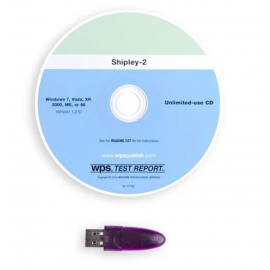
Unlimited-Use Computer Scoring CD
• Quick, accurate scoring
You can substantially reduce scoring time while minimizing the chance of error—whether you’re scoring paper-and-pencil or computer administrations. Scale and composite scores are calculated instantly.
• On-screen administration
You can now administer the Shipley-2 directly on your computer. Convenient and user-friendly, on-screen administration duplicates the paper-and-pencil test experience—but eliminates the need for test forms.
• Flexibility
You can administer the Vocabulary, Abstraction, and Block Patterns scales individually or in any combination. You can also choose between timed or untimed administration.
• A clear and complete score report
You get a clear, accurate, and complete record of test results, including a graphical representation of standard scores and percentile ranks for each scale and for Composites A and/or B.
Shipley-2 Calculator
The tool below can be used to calculate the AQ or BQ impairment index for the Shipley-2. The AQ is calculated for individuals who complete the Vocabulary and Abstraction scales, and the BQ is calculated for people who complete the Vocabulary and Block Patterns scales. The AQ and BQ are calculated only for adults who are no longer in school.
To use the calculator, enter the Vocabulary raw score, age in years, years of school completed, and either the Abstraction or Block Patterns raw score, depending on which test was completed. All the data should be entered as whole numbers within the indicated ranges. Once these four fields are filled in, click "Get AQ" or "Get BQ." The result is rounded to the nearest whole number. The reset button can be used to clear all fields.
The AQ and BQ are derivative deficit scores They have meaning only when used in conjunction with the Shipley-2 primary measures of ability that are obtained using standard test materials and the scoring appendixes of the Shipley-2 manual. These primary scores are not available via this calculator. Examples of limited and proper interpretation of the AQ and BQ are provided in the test manual.
See chapter 3 of the Shipley-2 Manual for more information about the impairment index and how to interpret the resulting AQ or BQ score.
Click here to open the Shipley-2 calculator.
Terms often used to search for Shipley-2
Shipley 2, shipley 2 assessment, shipley 2 test, test, scale, manual, scoring
Case Examples:
Ruling Out Neurological Impairment
Mrs. Miles was a 68-year-old woman whose behavior had changed in the year following the death of her husband. She was referred by her daughter, who was concerned about her mother’s increasing forgetfulness, tendency to “space out,” and neglect of her physical health.
The Shipley-2 was included in the psychological test battery to provide a quick index of Mrs. Miles’s overall intellectual functioning and to screen for neurological problems. Scale scores showed average ability, though her Impairment Index score was calculated to be 88—just below the “within normal limits” cutoff. Though not alarming, this score warranted additional neuropsychological testing, which revealed nothing unusual. A depression rating scale, however, indicated significant depressive symptoms.
Mrs. Miles was diagnosed as suffering from an adjustment disorder with depressed mood. She was treated with a combination of antidepressant medication and psychotherapy, and after 3 months of treatment she reported improved mood. Additionally, her forgetfulness decreased, and her daughter reported that Mrs. Miles seemed “more like her old self.”
Confirming Ability for Job Placement
Mr. Lewis, a 32-year-old male, was given the Shipley-2 when he applied for a position in financial sales and management. Although Mr. Lewis had a very successful and stable work history, he had only a high school education. His prospective employer wanted to make sure that Mr. Lewis had the cognitive flexibility and problem solving skills required in the position for which he was being considered.
His Shipley-2 scores revealed average ability on the Vocabulary scale (standard score = 100), which was consistent with his level of education. However, his Abstraction score was well above average (126), indicating that he had sufficient reasoning ability to do the job. By quickly assessing both crystallized and fluid intelligence, the Shipley-2reassured the employer that Mr. Lewis was qualified even though his acquired knowledge was less than that of other applicants.
Mr. Lewis was hired and very early on proved to be a strong manager.
Clarifying Other Test Results
Nine-year-old Alison was referred by her teacher for a comprehensive psychoeducational evaluation. Her teacher described Alison as “painfully shy,” preferring solitary activities, and performing poorly in a classroom that utilized cooperative learning.
On the WISC-IV, Alison’s Full Scale IQ was 89. Her performance abilities were strong, while her verbal skills appeared weak. However, the school psychologist was not convinced that these results were a valid reflection of Alison’s verbal abilities because Alison had appeared timid and wary during test administration. The psychologist thought the social interaction aspect of the WISC-IV might have affected Alison’s scores.
Therefore, the Shipley-2 was administered to see if Alison would do better on a paper-and-pencil test. As suspected, she performed significantly better on the Shipley-2Vocabulary scale than she had on the WISC-IV Vocabulary Subtest. The psychologist concluded that her Composite A score (104) was a more accurate reflection of Alison’s overall ability than her WISC-IV Full Scale IQ.
Given these results, the psychologist administered depression and anxiety scales and found that Alison was exhibiting clinically significant difficulties that were affecting both her social interaction and her academic performance.
Determining Eligibility for Disability Benefits
Ms. Smith, a 24-year-old female, was referred by the state for an evaluation to determine eligibility for disability benefits. She reported that she suffered from cognitive limitations that prevented her from successfully obtaining and keeping a job. Ms. Smith had no known psychological or psychiatric diagnoses and no general health problems.
The WAIS-III indicated that Ms. Smith had a Verbal IQ of 70, Performance IQ of 76, and Full Scale IQ of 70. The examiner noted that Ms. Smith seemed to respond somewhat haphazardly to items, and an examination of her protocol revealed atypical response patterns (easier items missed while more difficult items were answered correctly).
Due to concerns about the validity of the WAIS-III results, the Shipley-2 was administered, and the standard scores were as follows: Vocabulary = 83, Abstraction = 84, and Composite A = 83. Again, item analysis called Ms. Smith’s scores into question. On the Vocabulary scale, she responded correctly to the first 18 items, then missed 5 in a row before answering 3 more correctly. On the Abstraction scale, she answered Item 23 correctly, which should have been far beyond her ability level.
To clarify these scores, a complete reevaluation was done. Results indicated that Ms. Smith did not suffer from cognitive impairment. She was denied disability benefits and referred to vocational training courses.